Himachal Pradesh Unveils First Comprehensive Roadmap to Cut Super Climate Pollutants and Protect Himalayan Ecosystems
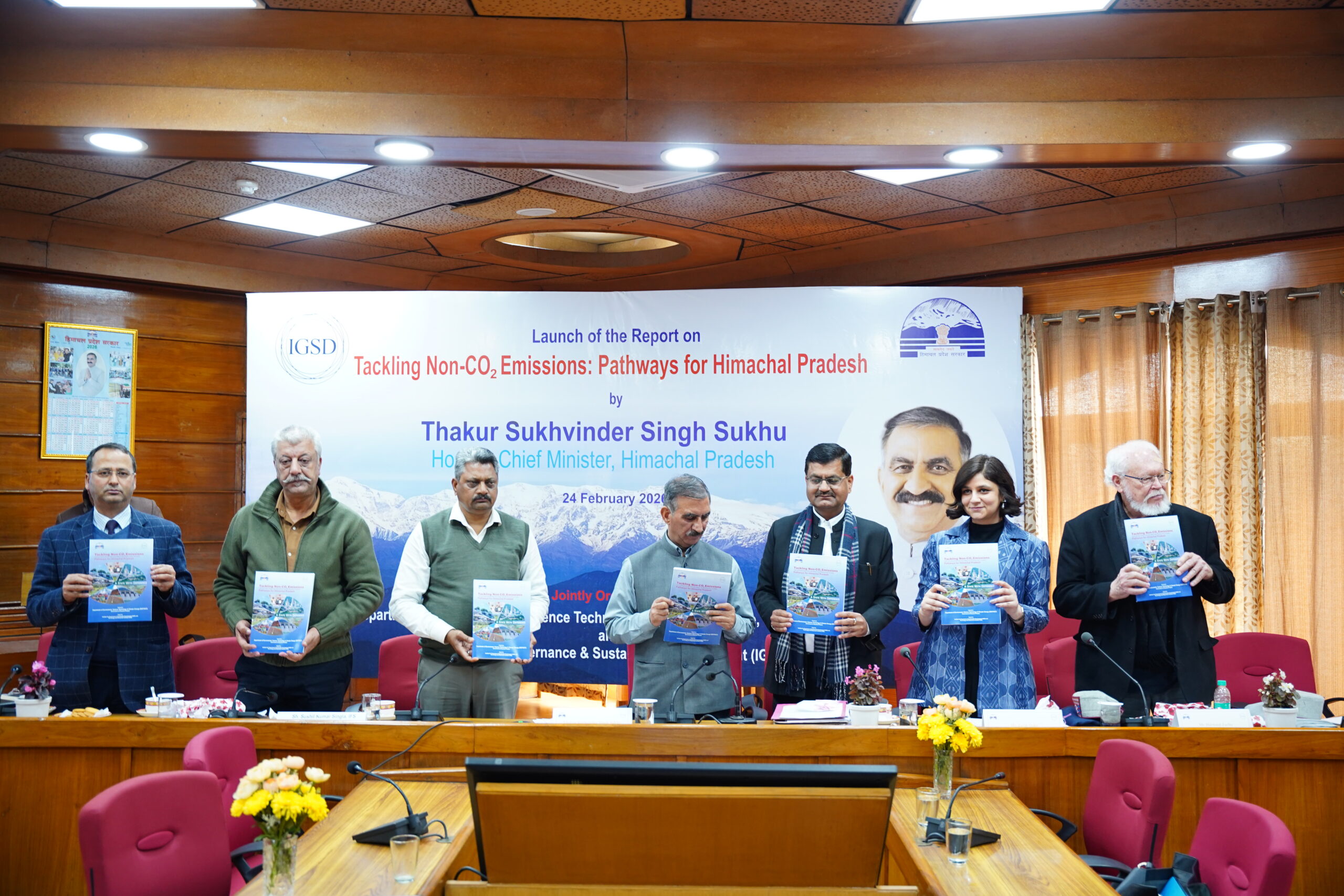
On 24 February 2026, the Government of Himachal Pradesh launched the state's first comprehensive emissions assessment and policy roadmap to tackle short-lived climate pollutants (SLCPs) and other non-CO₂ emissions, in a ceremony held in Shimla. The report, Tackling Non-CO₂ Emissions: Pathways for Himachal Pradesh, establishes a 2019 emissions baseline and models sector-specific pathways through 2047. The report was developed by the Department of Environment, Science, Technology & Climate Change, Government of Himachal Pradesh, in partnership with the Institute for Governance & Sustainable Development (IGSD) and The Energy and Resources Institute (TERI).
Hon’ble Chief Minister Sukhvinder Singh Sukhu, present at the launch of the report, said:
“Protecting our glaciers, rivers, and mountain ecosystems is a responsibility we owe to future generations. This report gives us a science-based roadmap to reduce harmful pollutants while strengthening livelihoods, hydropower reliability, and public health. Himachal Pradesh will continue to lead with evidence-based climate action. I congratulate all partners who have helped in the development of the report. Building knowledge pools like this can only support our plans to ensure a sustainable future for our state.”
Sushil Kumar Singla, Secretary (Environment, Science & Technology and Climate Change), Himachal Pradesh, said:
“Our state’s unique terrain, high-elevation, and rapidly-expanding urban spaces make us more vulnerable to the impacts of Short-Lived Climate Pollutants such as black carbon and methane. These degrade air quality and contribute to glacier melt, which, in turn, threatens water security, agriculture, hydropower, and disaster resilience. This report, with its rigorous scientific assessment of non-CO₂ emissions, is a critical reference framework in that respect. It also spotlights actionable solutions across key sectors.”
DC Rana, Director, Department of Environment, Science, Technology & Climate Change, said:
“Increasingly, and at a steady pace, Himachal Pradesh has witnessed shifts in its climate. From excess rainfall, including extremely heavy rainfall days, to heat stress, which has started impacting hilly regions as well, the adverse effects of a warmer climate are coming to pass now. These have a ripple effect: for instance, warmer and drier conditions increase forest fire incidences, which lead to black carbon emissions that deteriorate air quality. Considering these overlapping climate and air-quality challenges, mitigating SLCPs becomes essential. This report will help to frame policies that address such SLCP challenges in the state.”
Durwood Zaelke, President of IGSD, emphasized the urgency of targeting super pollutants. He said:
“For a Himalayan state like Himachal Pradesh, cutting methane and black carbon is the fastest strategy available for turning down the heat. These pollutants are driving near-term warming and amplifying the pace of glacier melt. This makes the report valuable for the state's policymaking and for the people of Himachal Pradesh to ensure a secure future in the face of changing climatic conditions.”
Vibha Dhawan, Director General, The Energy & Resources Institute (TERI), said:
“Climate change is not an abstraction in the world today. Especially for vulnerable Global South countries, the ramifications of negative environmental changes are high. In India, Himachal Pradesh – with its sensitive ecology and landscape – is a critical state from the lens of a rapidly changing climate. But if we need to formulate targeted policies to save fragile ecosystems, we need precise data to work with. To this end, the report offers a range of data-led insights and policy actions that can support the important work the state government is already doing. With collective effort, we can realize the goal of a climate-resilient Himachal Pradesh.”
Carolina Urmeneta, Waste and Circular Economy Program Director at the Global Methane Hub, said:
“The launch of a comprehensive SLCP emissions policy roadmap by the government of Himachal Pradesh will help build resilience of the most pristine and eco-sensitive zones of the country, while contributing to temperature reductions by addressing methane, especially in the waste and agriculture sector (accounting for a large share of the methane emissions). The report shows that practical and cost-effective solutions exist, and the policy actions that ensue have the potential to deliver improved livelihoods and better public health outcomes to the citizens and rural communities of Himachal Pradesh. We commend the leadership shown in publishing this policy, while emphasizing that real impact depends on its effective implementation, which is of regional and global importance in the global climate crisis, and supports India’s net zero targets under the Paris Agreement."
Zerin Osho, Director, IGSD India, said:
“We cannot change what we cannot measure. This report addresses that challenge by providing the right data sets and policy tools to act now and to track progress over time. This is more than an emissions inventory. It is a decision-support framework for departments, districts, and investors. By integrating air quality and climate action, Himachal Pradesh can secure rapid climate benefits while improving public health and rural incomes.”
Read the full report, Tackling Non-CO₂ Emissions: Pathways for Himachal Pradesh, here or on the Himachal Pradesh Department of Environment website.
See the Government of Himachal Pradesh press release here.